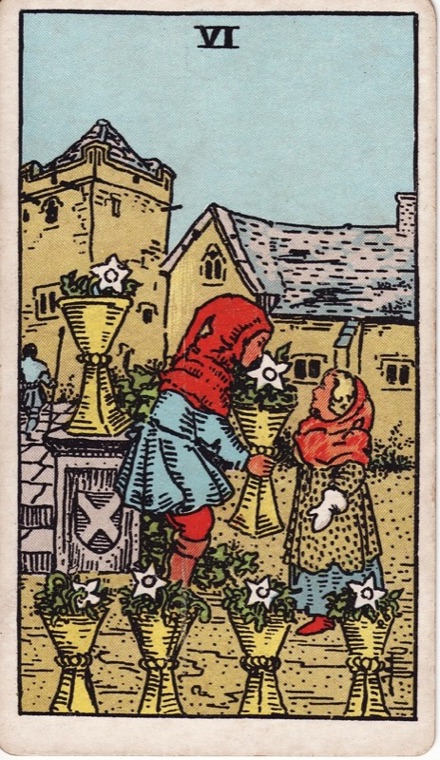
A woman places a coin in a boy's open hand; cut flowers fill two cups beside a blooming garden.
Six of Cups
Upright
One child fills a cup with flowers and offers it to another, smaller one, and the whole air smells like a summer that has already passed. The Six of Cups is sweetness with roots: an old friend resurfacing, a kind gesture, a return to something simple and true. Reconnecting with the past can heal you — just visit it; do not move back in. Let the memory nourish the present instead of replacing it.
Reversed
You may be living in a photo album. Reversed, the Six of Cups warns that nostalgia has curdled into avoidance — an ex idealized beyond recognition, the past edited into something it never was. The future is not worse than your memories; it is just unedited. Come back to today, where new sweetness can actually grow.
Where is this energy showing up in your life right now?
Why this card looks like this
The painting is not decoration — every object in it is doing a job.
A woman puts a single coin into the open hand of a boy, and behind them a garden blooms beside two cups filled with flowers. The grammar is generosity moving downward, from someone who has to someone who is still learning what to do with what is given. The coin makes the gift plain and modest, the boy keeps the receiving end innocent, and the flower-filled cups behind them turn the whole scene toward memory, a past that has been cut and kept rather than a future being grown.
The flowers in the two cups have been cut, not picked from a living plant, and they still bloom perfectly because they are no longer growing, while a step behind them leads back to a house, so the gift is not really the coin but a direction toward home. Another overlooked beat: the boy's eyes are on her face, not on the money landing in his palm.
Ask what was handed to this person that they have kept as a story rather than as an object, and let the cut flowers carry that weight: which part of them has been preserved by being removed from growth. The boy watching her face sets the direction of the question, so ask what they long to give that cannot be bought, and who they still feel they owe something to from the past.