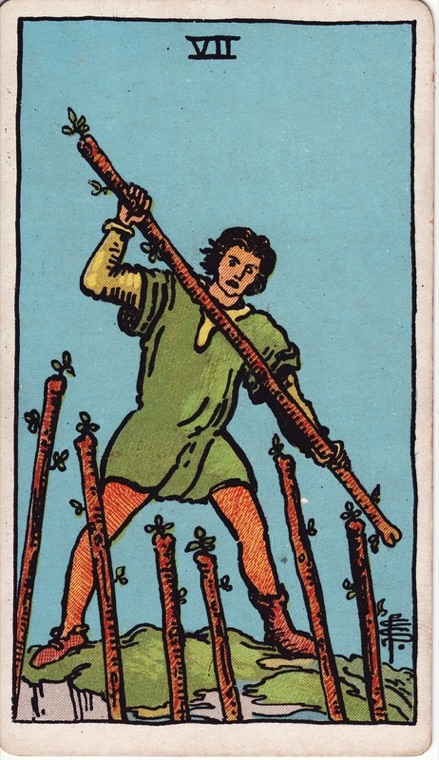
One man braces a wand across his waist on a green slope while six smaller figures turn away below.
Seven of Wands
Upright
You're on high ground for a reason — you earned it, and now everyone below wants a piece of it. The Seven of Wands is the exhausting but honorable work of defending what you've built: your boundaries, your pricing, your vision against the doubters. You don't have to win every fight today; you just have to not abandon the ridge. Hold your position — the advantage is real and it's yours.
Reversed
Are you defending a hill worth defending, or just tired and digging in out of pride? Reversed, the Seven of Wands asks whether some of these battles are yours to fight at all. Overwhelm can make every criticism feel like an attack, but strategic retreat is not defeat. Consider which positions genuinely matter, release the rest, and come back to the one fight that counts with fresh legs.
Where is this energy showing up in your life right now?
Why this card looks like this
The painting is not decoration — every object in it is doing a job.
One man stands on the higher slope with his wand held like a staff, and half a dozen smaller figures below are being pressed back down it, so the card is about the cost of holding your ground. Nothing is being built here: the position is kept by leaning, and the green hillside makes the whole scene look effortless from the outside.
Look at his grip: the wand is held across the body at waist height and braced with both hands, which is a wrestler's stance rather than a soldier's salute. And the people below are turning away instead of climbing, so this defence has already cost more than it has won.
Point to the slope and ask how long he means to hold it, and what it is costing him each week. The people walking away are not the point; the point is that a position defended alone gradually turns into the job itself.