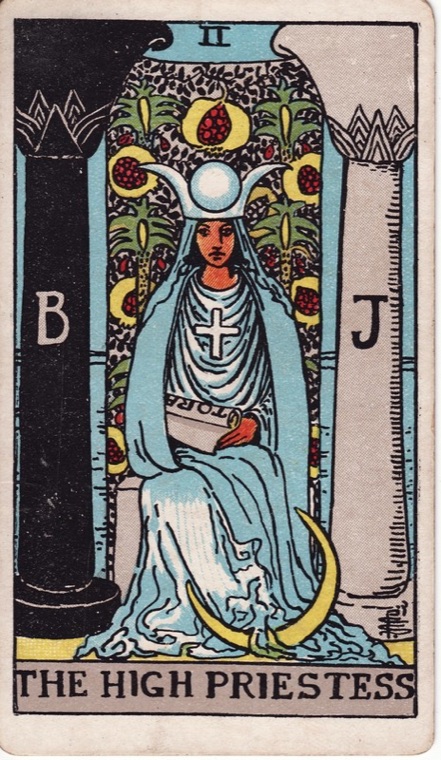
She sits between a black pillar and a white one, a scroll half-hidden beneath her robe.
The High Priestess
Upright
Between the pillars sits what you already know but haven't said out loud. The High Priestess is the pause before the answer — the knowing in your body before logic catches up. Don't force it. Sit with the question tonight; the answer tends to arrive quietly.
Reversed
You've been outsourcing your inner voice — to feeds, to friends, to anyone louder than your own knowing. Reversed, the Priestess calls you back inward. Turn the volume down; the signal is faint but it is yours.
Where is this energy showing up in your life right now?
Why this card looks like this
The painting is not decoration — every object in it is doing a job.
She sits exactly in the middle, between a black pillar marked B and a white one marked J, with a veil of pomegranates hung between them. Nothing in the painting is doing anything, which is the point: the card is stillness with authority. The scroll at her side is half-covered by her robe, and she is not holding it out.
Read the two pillars as a thesis and an antithesis, not as good and evil — the white one is marked J for Job, the black one B for Boaz, both names in a lineage. The crescent moon at her feet is the moon of the zodiacal waters, which is why this card sits under the Moon and not the Sun. And on her breast is a cross and a crescent, two symbols that most decks never explain.
When this card appears, the useful move is to stop talking for a moment and let the querent fill the silence. Then ask what they already know but have not said. If they insist there is nothing there, that insistence is itself the answer — she is the card of the thing that has not been brought into the light yet.