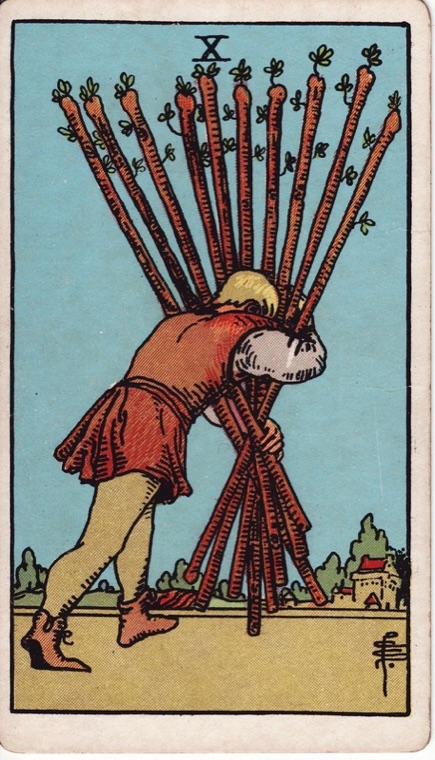
A man folds almost double under ten staves clutched in his arms, a small village ahead of him.
Ten of Wands
Upright
You're carrying all of it — every deadline, every duty, every promise you made when you had more energy. The Ten of Wands shows the weight of success in motion: this burden is real, but so is the destination just ahead of you. The honest question isn't whether you're strong enough; it's which bundles were never yours to hold. Set the house down before you cross the threshold, or you won't be able to walk through the door.
Reversed
The load is spilling everywhere, and pretending it's fine is the heaviest part of all. Reversed, the Ten of Wands offers you official permission to delegate, quit, and say the sentence 'I can't carry this alone' out loud. Sometimes it signals a burden finally set down and the relief of lightness returning. Either way, stop treating martyrdom as a personality trait — even pack animals get rest stops.
Where is this energy showing up in your life right now?
Why this card looks like this
The painting is not decoration — every object in it is doing a job.
The man is folded almost double under a load of ten staves, and the town ahead of him shows the work is nearly done, which is exactly why this card feels like an ending that has not been allowed to finish. The pose is a body carrying everything alone; these wands are not his idea, they are his responsibility, and the distance to home is measured in how much he is still carrying.
His face is turned up towards what he is carrying rather than ahead towards the village, so even the destination is being ignored under the weight. And the staves are carried in his arms like firewood, not on a cart — the card's real subject is the difference between a heavy thing and an unnecessarily heavy way of carrying it.
Ask what would happen if he handed half of it to someone else before walking the last stretch, because the town is already in sight — the question is not whether this ends, but why the ending has to be solo. This card is the last mile, where delegating feels most urgent and is most resisted.