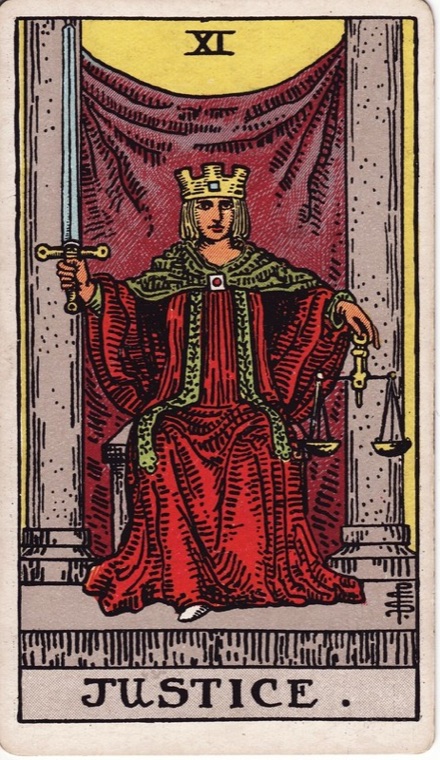
Justice
Upright
The scales do not care whose story is more comfortable. Justice is the card of honest accounting: what is true, what is yours, what is owed. Face the fact you've been avoiding — the fair outcome, and the free one, live on the other side of it.
Reversed
A verdict made from bias, blame outsourced, or a truth half-told — including to yourself. Reversed, Justice warns that unresolved unfairness compounds like interest. Reopen the case, honestly this time.
Where is this energy showing up in your life right now?
Why this card looks like this
The painting is not decoration — every object in it is doing a job.
A crowned figure with a sword held perfectly upright in the right hand and scales levelled in the left, seated between a purple veil and a pair of pillars. The sword is not a weapon here — it is a plumb line, the straightest thing a painter could draw. Behind the throne two grey curtains hang, and the veil is the colour of the sky at the moment of judgement.
The sword is in the right hand and the scales in the left: cause before consequence, principle before measurement. Look at the veil behind her and you will see the same purple that appears on the High Priestess's pomegranate curtain — Justice and intuition share a colour, which is a quiet hint that fairness is not the same as coldness. Her crown is simple, almost unadorned.
Justice wants the question turned into something answerable. Ask the querent to state the situation in terms of what they did and what they want — no feelings, no narrative. Then ask what the honest answer would cost. The scales are level in the painting because fairness is not the same as comfort, and the card will not move until both sides are on the table.