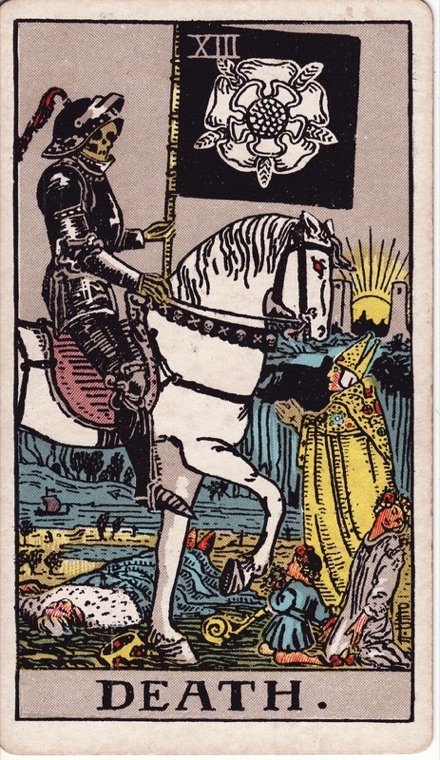
A skeleton on a white horse, carrying a black banner with a single white rose.
Death
Upright
Almost never literal: Death is the necessary ending — the lease, the job, the identity, the version of you that the next chapter cannot carry. Stop resuscitating what has already finished its work. Clearing the ground is how the new light gets in.
Reversed
Clinging to the shell after the change has already happened — the cost is paid daily in stagnation. Reversed, Death asks: what would you do this week if you truly accepted that this chapter is over?
Where is this energy showing up in your life right now?
Why this card looks like this
The painting is not decoration — every object in it is doing a job.
A skeleton in black armour rides a white horse, holding a black banner on which a white rose is embroidered — a rose, five petals, the same flower the Fool carries. The horse walks calmly, and the fallen are a king, a bishop, a child and a maiden: nobody is spared because nobody is exempt. Behind them the sun rises between two towers.
The white rose on the banner and the white rose in the Fool's hand are the same symbol, one ending and one beginning — Colman Smith tied the deck together with that flower. Look at the horizon: this is the only major arcana where the sun is rising while the card is called death. The card is about the dawn, and we just keep calling it the end.
Death is almost never literal, and it is almost never about the end of the thing. Ask what has to stop for something else to start, and who among the people involved is currently acting as though they were exempt. The card is often kind: it is the only one that guarantees the sunrise is real.